2020.06.14 nahamconCTF

Nahamcon 2020 Crypto - Homecooked

CTF writeup: NahamCon 2020's Homecooked leaves its prime-palindrome XOR decoder simmering in trial division. gmpy2's primality test cuts the cooking time.

Event
nahamconCTF
Category
crypto
Topic
Encoding
Published
Markdown source Attached files Read article
Cite

Copy this citation into your bibliography, or download the BibTeX file.

Download .bib

Homecooked

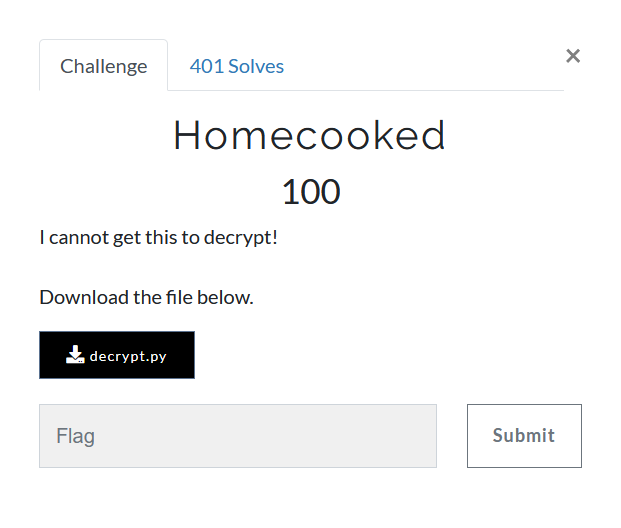
Homecooked challenge page: 100 points, 401 solves, prompt 'I cannot get this to decrypt!', and a decrypt.py download.

We are provided decrypt.py, the contents of which read

Python
import base64
num = 0
count = 0
cipher_b64 = b"MTAwLDExMSwxMDAsOTYsMTEyLDIxLDIwOSwxNjYsMjE2LDE0MCwzMzAsMzE4LDMyMSw3MDIyMSw3MDQxNCw3MDU0NCw3MTQxNCw3MTgxMCw3MjIxMSw3MjgyNyw3MzAwMCw3MzMxOSw3MzcyMiw3NDA4OCw3NDY0Myw3NTU0MiwxMDAyOTAzLDEwMDgwOTQsMTAyMjA4OSwxMDI4MTA0LDEwMzUzMzcsMTA0MzQ0OCwxMDU1NTg3LDEwNjI1NDEsMTA2NTcxNSwxMDc0NzQ5LDEwODI4NDQsMTA4NTY5NiwxMDkyOTY2LDEwOTQwMDA="

def a(num):
    if (num > 1):
        for i in range(2,num):
            if (num % i) == 0:
                return False
                break
        return True
    else:
        return False

def b(num):
    my_str = str(num)
    rev_str = reversed(my_str)
    if list(my_str) == list(rev_str):
       return True
    else:
       return False


cipher = base64.b64decode(cipher_b64).decode().split(",")

while(count < len(cipher)):
    if (a(num)):
        if (b(num)):
            print(chr(int(cipher[count]) ^ num), end='', flush=True)
            count += 1
            if (count == 13):
                num = 50000
            if (count == 26):
                num = 500000
    else:
        pass
    num+=1

print()

Here two functions a and b are of primary focus,

Python
def a(num):
    if (num > 1):
        for i in range(2,num):  #From all numbers from 2 to num - 1
            if (num % i) == 0:  #check if the number i divides num
                return False    #if it divides, then its composite
                break
        return True  # No such number found hence prime
    else:
        return False

Seems like, its looping over all possible numbers to check if the provided number num is a prime or not

Python
def b(num):
    my_str = str(num) # string representation of number
    rev_str = reversed(my_str)  # reverse the string
    if list(my_str) == list(rev_str): # check if both equal
       return True  # the input is a palindrome
    else:
       return False

This function just checks if num is a palindrome

The cipher_b64 is simply a base64 encoding of a comma separated list of numbers

Plain text
100,111,100,96,112,21,209,166,216,140,330,318,321,70221,70414,70544,71414,71810,72211,72827,73000,73319,73722,74088,74643,75542,1002903,1008094,1022089,1028104,1035337,1043448,1055587,1062541,1065715,1074749,1082844,1085696,1092966,1094000

It is simply taking number from the list and xoring with next prime-palindrome to give the character in sets of 13. Lets simply run the decrypt.py to see what happens

Plain text
python3 decrypt.py
flag{pR1m3s_4re_co0ler_Wh3

Hmm, seems stuck. What’s the issue?
The issue is with function a which checks for prime by dividing it by all numbers.
This can be done pretty efficiently by better primality tests.
One could simply use is_prime from gmpy2 library of python and replace the function a
Python
import base64
import gmpy2
num = 0
count = 0
cipher_b64 = b"MTAwLDExMSwxMDAsOTYsMTEyLDIxLDIwOSwxNjYsMjE2LDE0MCwzMzAsMzE4LDMyMSw3MDIyMSw3MDQxNCw3MDU0NCw3MTQxNCw3MTgxMCw3MjIxMSw3MjgyNyw3MzAwMCw3MzMxOSw3MzcyMiw3NDA4OCw3NDY0Myw3NTU0MiwxMDAyOTAzLDEwMDgwOTQsMTAyMjA4OSwxMDI4MTA0LDEwMzUzMzcsMTA0MzQ0OCwxMDU1NTg3LDEwNjI1NDEsMTA2NTcxNSwxMDc0NzQ5LDEwODI4NDQsMTA4NTY5NiwxMDkyOTY2LDEwOTQwMDA="

def a(num):
    return gmpy2.is_prime(num)


def b(num):
    return str(num) == str(num)[::-1]

cipher = base64.b64decode(cipher_b64).decode().split(",")

while(count < len(cipher)):
    if (a(num)):
        if (b(num)):
            print(chr(int(cipher[count]) ^ num), end='', flush=True)
            count += 1
            if (count == 13):
                num = 50000
            if (count == 26):
                num = 500000
    else:
        pass
    num+=1

print()

Now running solve.py spews the flag instantly

flag{pR1m3s_4re_co0ler_Wh3n_pal1nDr0miC}