2020.06.14 nahamconCTF

Nahamcon 2020 Crypto - Unvreakable Vase

Nahamcon 2020 Crypto - Unvreakable Vase writeup: cryptography, base64

Event
nahamconCTF
Category
crypto
Topic
Encoding
Published

Unvreakable Vase

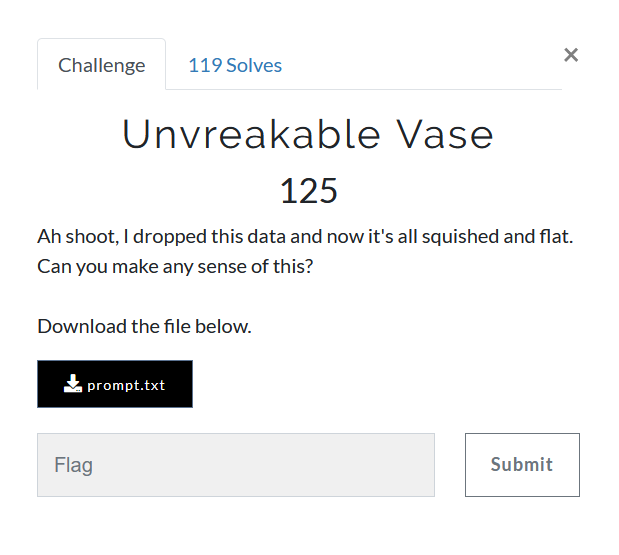
Challenge page showing 119 solves, 125 points, and the clue that the dropped data is "all squished and flat."

We are provided with prompt.txt, which reads

Plain text1 line / static highlight
zmxhz3tkb2vzx3roaxnfzxzlbl9jb3vudf9hc19jcnlwdg9vb30=

This seems to be base64 encoded but I think all the letters are converted to lowercase as hinted by squished and flat

Python6 lines / static highlight
import base64
data = 'zmxhz3tkb2vzx3roaxnfzxzlbl9jb3vudf9hc19jcnlwdg9vb30='
m1 = base64.b64decode(data)
print(m1)

#b'\xcela\xcf{dok\xf3\xc7z\xe8k\x19\xdf\xcf\x1c\xe5n_co{\xeeu\xffas_crypv\x0foo}'

Lets try captilizing the first ‘z’

Python6 lines / static highlight
import base64
data = 'zmxhz3tkb2vzx3roaxnfzxzlbl9jb3vudf9hc19jcnlwdg9vb30='
m1 = base64.b64decode(data)
print(m1)

#b'fla\xcf{dok\xf3\xc7z\xe8k\x19\xdf\xcf\x1c\xe5n_co{\xeeu\xffas_crypv\x0foo}'

Seems to be it, now our flag begins with fla.
All we need to do is keep capitalizing the letters of data such that base64 decoding results in a ASCII string which is readable.

One can do this by hand. NOT ME 😛

To automate this shit, lets take a look at how base64 actually works.
In base64, we have 64 possible characters, which means each base64 letter can hold 6 bits.
Which in turn means 4 base64 characters = 24 bits = 3 bytes
So instead of taking all 52 characters of prompt together and then checking 2**52 possibilities, we can simply take 4 characters at a time, and thenn checking 2**4 possibilites for output in the desired character set.
Python26 lines / static highlight
from base64 import b64decode as decode
from itertools import product

data = 'zmxhz3tkb2vzx3roaxnfzxzlbl9jb3vudf9hc19jcnlwdg9vb30='
CHARSET = 'abcdefghijklmnopqrstuvwxyz_{}'


def case_variations(string):
    possibilities = []
    for char in string:
        possibilities.append([char.lower(), char.upper()])
    return ["".join(perm) for perm in product(*possibilities)]


flag = b""
real_data = ""
for i in range(0, len(data), 4):
    crib = data[i:i + 4]
    for case_variation in case_variations(crib):
        if all(chr(char) in CHARSET for char in decode(case_variation)):
            real_data += case_variation
            flag += decode(case_variation)
            print(flag)
            break

print(real_data)

Which prints out stuff

Python14 lines / static highlight
b'fla'
b'flag{d'
b'flag{does'
b'flag{does_th'
b'flag{does_this_'
b'flag{does_this_eve'
b'flag{does_this_even_c'
b'flag{does_this_even_coun'
b'flag{does_this_even_count_a'
b'flag{does_this_even_count_as_c'
b'flag{does_this_even_count_as_cryp'
b'flag{does_this_even_count_as_cryptoo'
b'flag{does_this_even_count_as_cryptooo}'
ZmxhZ3tkb2VzX3RoaXNfZXZlbl9jb3VudF9hc19jcnlwdG9vb30=

And our original base64 encoded string was 'ZmxhZ3tkb2VzX3RoaXNfZXZlbl9jb3VudF9hc19jcnlwdG9vb30='

flag{does_this_even_count_as_cryptooo}