We are provided with prompt.txt, the contents of which read
Plain text
1
2
3
n = 7735208939848985079680614633581782274371148157293352904905313315409418467322726702848189532721490121708517697848255948254656192793679424796954743649810878292688507385952920229483776389922650388739975072587660866986603080986980359219525111589659191172937047869008331982383695605801970189336227832715706317
e = 65537
c = 5300731709583714451062905238531972160518525080858095184581839366680022995297863013911612079520115435945472004626222058696229239285358638047675780769773922795279074074633888720787195549544835291528116093909456225670152733191556650639553906195856979794273349598903501654956482056938935258794217285615471681
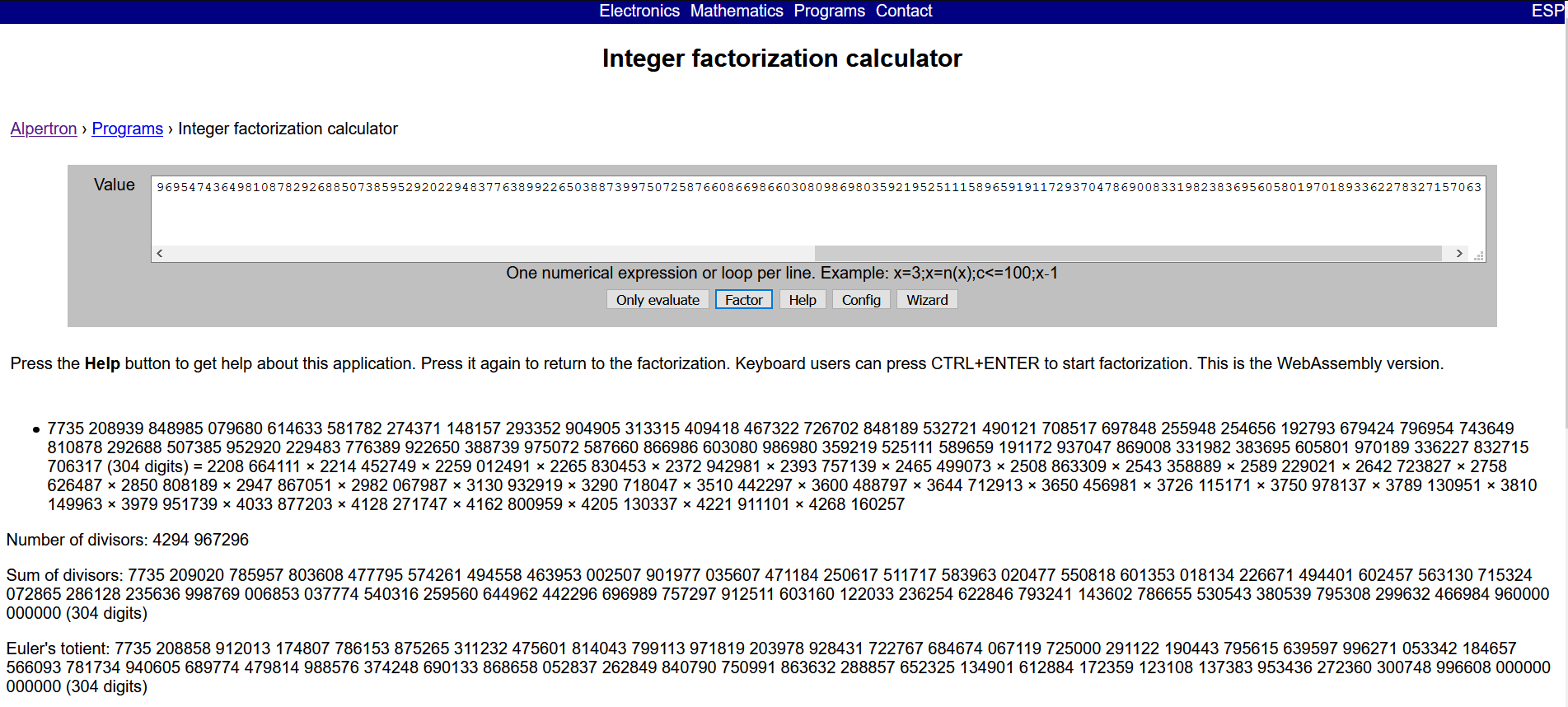
Lets again head to alpetron, suspecting there may be a lot of small prime factors
Which almost instantly factors the N using Elliptic Curve Method indicating my suspicion was true.
Now we have a lot of prime factors, one may simply grab the Euler’s Totient, I however prefer working over primes to demonstrate how its calculated
Python
1
2
3
4
5
6
7
8
9
10
11
12
13
14
fromgmpy2importinvertfrommathimportprodn=7735208939848985079680614633581782274371148157293352904905313315409418467322726702848189532721490121708517697848255948254656192793679424796954743649810878292688507385952920229483776389922650388739975072587660866986603080986980359219525111589659191172937047869008331982383695605801970189336227832715706317e=65537c=5300731709583714451062905238531972160518525080858095184581839366680022995297863013911612079520115435945472004626222058696229239285358638047675780769773922795279074074633888720787195549544835291528116093909456225670152733191556650639553906195856979794273349598903501654956482056938935258794217285615471681factors=[2208664111,2214452749,2259012491,2265830453,2372942981,2393757139,2465499073,2508863309,2543358889,2589229021,2642723827,2758626487,2850808189,2947867051,2982067987,3130932919,3290718047,3510442297,3600488797,3644712913,3650456981,3726115171,3750978137,3789130951,3810149963,3979951739,4033877203,4128271747,4162800959,4205130337,4221911101,4268160257]phi=prod(i-1foriinfactors)# cool new function in python3.8 ;)
# just take the product of prime - 1 for all primes to calculate phi
# since no prime is repeated
d=invert(e,phi)m=pow(c,d,n)print(bytes.fromhex(hex(m)[2:]).decode())
If you got stuck over the challenge, I would suggest reading wikipedia for more information.