I keep passing up perfectly good line clears in The New Tetris because I want to finish a square. The N64 game rewards you for packing four whole tetrominoes into a 4x4 region. With three pieces already lined up, I’m much more interested in finding the fourth than clearing the board.
Four pieces of the same shape turn gold; a mixture turns silver. Four T pieces can make this:
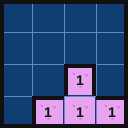
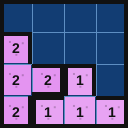
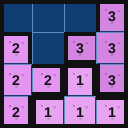
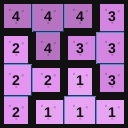
I wanted more of that, so I made Tetrasquares, a browser game with 6x6 and 8x8 squares as well. I also changed the scoring to give interlocking arrangements some extra points. Four O pieces and four interlocking Ts both make gold, but I like the T square enough to pay it more.
The bit I borrowed from the N64 game
The New Tetris came out in 1999. Its manual calls the gold and silver constructions Mono-Squares and Multi-Squares. Silver can contain repeated shapes: two Ls and two Os work, for example. All four pieces must be intact, with no holes or bits sticking outside the square. You can’t build one out of leftovers from earlier line clears.
You collect the reward by clearing rows through the finished square. The manual gives five collected lines per silver-square row and ten per gold-square row, compared with one for an ordinary row. The wiki’s arithmetic differs; I’ve left a note with the references rather than mixing those numbers into my scoring rules.
That delay is part of what I enjoy. Before the square forms, a line clear can ruin it. After it forms, I want to clear through it. Hold helps with keeping a useful piece around, but I still have to leave somewhere for the rest of the queue to go. The square-building guides have a lot to say about platforms for exactly this reason.
Four pieces fit together in quite a few ways
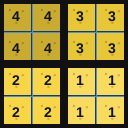
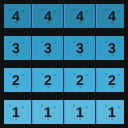
O4 and I4 are the easy gold squares: four little squares, or four strips.
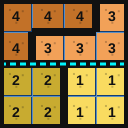
For silver, I can join two 2x4 rectangles made from two pieces each. Another option is a three-piece 3x4 assembly with an I across the top. These are handy recipes because I can work on a smaller rectangle while waiting for the piece that finishes it.
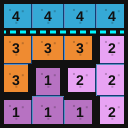
The T square has no such seam. Any straight cut across the whole square goes through at least one piece. J pieces can make a spiral too; the L arrangement below uses two separable pairs instead. Ls can also spiral, but this particular catalog example doesn’t.
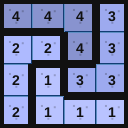
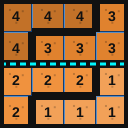
I also like the two-L, two-Z square. Reflecting its piece mix gives two Js and two Ss. The slanted pieces fit between the hooks, and both of these arrangements have half-turn symmetry.
Paying extra for an interlock
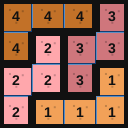
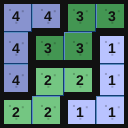
I kept the gold bonus and added a test for a clean cut: a horizontal or vertical line that crosses the whole region without cutting a piece. O4 has clean cuts in both directions. T4 has none.
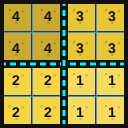 2,500 pending
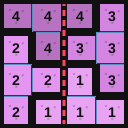 3,500 pending
For a 4x4 square, I add up:
| Award | Points |
|---|---|
| Base | 1,000 |
| Gold | +1,500 |
| Each distinct shape after the first | +250 |
| No clean cut | +1,000 |
That makes O4 worth 2,500 and T4 worth 3,500. The silver comparison works the same way: L2-O2 gets 1,250, while L2-Z2 gets 2,250. The extra thousand buys the interlock in each case. O4 still beats L2-Z2 overall; I wanted gold to remain worth chasing.
This bonus only looks at geometry. It doesn’t know whether the queue is being helpful or whether I’ve built the whole thing on top of a mess.
These are pending points. Making O4 attaches 2,500 points to it, split into four shares of 625. Clear one of its rows and collect that row’s share, plus the ordinary line-clear points. The scoring page has the full rules, including what happens when a larger square contains smaller ones.
Six by six takes nine pieces
There is room for a T4 interlock inside a 6x6 square, with five Os filling the rest. Giving that the same structural bonus as a nine-piece interlock would be a bit generous. So I try the clean cuts recursively and choose the decomposition whose largest unsplittable group is smallest.
The first construction below comes apart into five individual Os and the four-T group. The second won’t come apart at all. Even its least damaging full cut goes through two pieces.
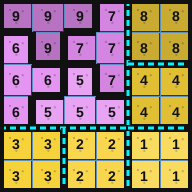 Shape bonus: 500
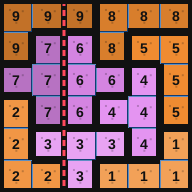 Shape bonus: 2,500
The 6x6 base is 2,500 points, gold adds 3,500, and each distinct shape after the first adds 500. Then I add the shape bonus:
| What remains after the best decomposition | Bonus |
|---|---|
| Largest group has 1 or 2 pieces | 0 |
| Largest group has 3 or 4 pieces | 500 |
| Largest group has 5 or 6 pieces | 1,000 |
| All 9 stay together; some full cut crosses just 1 piece | 1,500 |
| All 9 stay together; every full cut crosses at least 2 pieces | 2,500 |
There are no seven- or eight-piece groups in that table. They would need rectangular regions of area 28 or 32, neither of which fits inside a 6x6 square.
Using all seven shapes is worth a decent bonus, though it doesn’t guarantee the highest score. The seven-type construction below gets 7,000. The six-type one gets 7,500 because its interlock earns another thousand, more than making up for the missing shape. Nine Os get 6,000.
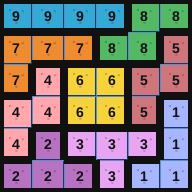 7,000 pending
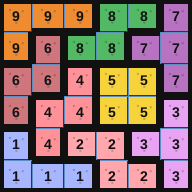 7,500 pending
Nine Ts won’t work at all. Checkerboard-color a 6x6 board and there are 18 cells of each color. A T always covers three of one color and one of the other, giving an imbalance of +2 or -2. Nine such imbalances can’t sum to zero. The little T4 spiral has no T9 equivalent.
The catalog
Butler, Ekstrand and Osborne count these tilings:
| Square | Pieces | Geometric tilings | Piece mixes |
|---|---|---|---|
| 4x4 | 4 | 117 | 24 |
| 6x6 | 9 | 178,939 | 1,467 |
| 8x8 | 16 | 19,077,209,438 | 30,434 |
A mix such as L2-Z2 says which pieces are used, not where they go. It can have several arrangements with different scores. These counts keep rotations and reflections when they give different tilings on the fixed board. They also include geometric tilings without promising that a falling-piece sequence can reach each one.
The catalog has one illustrated, checked construction for every 4x4 and 6x6 mix: 1,491 examples altogether. Its step slider shows how they go together. The platforming guide is useful background here; a finished tiling hides all the trouble you can have getting a piece into place.
Each example links to practice mode, which supplies its pieces in order without gravity. A wrong drop leaves the board alone, and there’s an optional placement outline. You can learn the construction without waiting for a friendly queue or trying to keep the rest of the board alive. Practice stops when the square is built; collecting its points is left to normal play.
Eight by eight takes most of the well
An 8x8 square needs sixteen pieces. In a ten-column well, centering it leaves one column on either side. Four copies of the T4 pattern fit together like this:
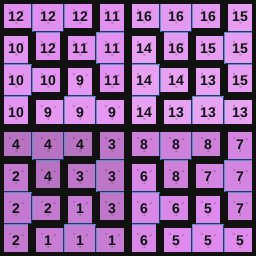 20,000 pending
I checked this order with a supplied T-only sequence under the browser game’s movement rules. For 8x8 I went with a flat 10,000 for silver and 20,000 for gold, collected across eight rows. There is no additional interlock or diversity bonus. Those smaller T4 squares can still have their own uncollected points attached when the big square forms.
The 8x8 catalog has counts by piece mix, but no construction orders or practice mode yet. You can build 8x8 squares in the full game. The four-T practice supplies the right queue if you want to try the spiral.
References
- The New Tetris instruction booklet, Nintendo, 1999. Printed page 9 describes Mono-Squares and Multi-Squares; page 11 describes collected-line rewards. These are PDF pages 11 and 13.
- The New Tetris, TetrisWiki. Release information, square rules, Hold, Spin Moves and scoring.
- Square Tetris, TetrisWiki. Square constructions and building methods.
- Square Platforming, Hard Drop. Supporting surfaces and placement order.
- The New Tetris, Hard Drop. Another account of the original rules and scoring; some material overlaps with TetrisWiki.
- TETRIS Tiling, Steve Butler, Jason Ekstrand and Steven Osborne. Geometric counts for tetromino tilings of squares.
A scoring wrinkle: the manual says five or ten collected lines per square row. TetrisWiki and Hard Drop describe additive bonuses and give 25 or 45 for a four-row clear through a silver or gold square. I haven’t resolved that disagreement by testing the N64 game. The point values in this post belong to Tetrasquares.